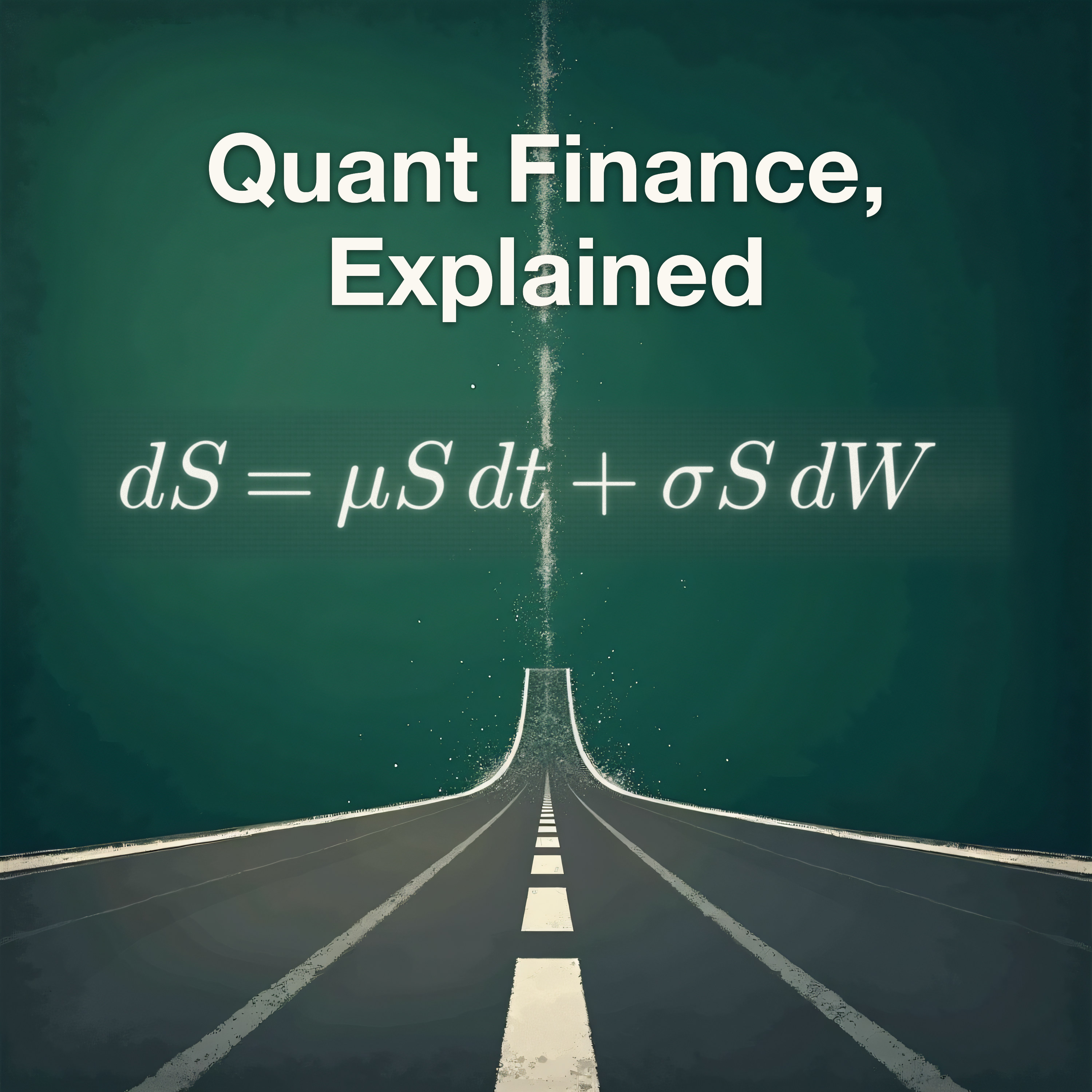
Episode 8 · September 24, 2026 · 17 min
The trade that removes risk: Black-Scholes
An option plus a hedge of delta shares is riskless over the next instant, so it must earn the risk-free rate; that sentence is the Black-Scholes equation
Course episode eight, Wilmott chapter six. Price an option that
expires in months on a stock that moves continuously. Hold the
option and sell delta shares against it; over the next instant the
slope terms cancel exactly and what is left is deterministic, the
option's time decay plus the curvature term from Ito's lemma. A
riskless portfolio must earn the risk-free rate, and setting those
equal is the Black-Scholes equation, stated in words. What fell out:
the stock's expected return never appears, only its volatility, the
continuous version of the binomial tree's lesson. From equation to
price: the payoff at expiry anchors it, and for a plain call the
answer is the Black-Scholes formula, read off the bell curve. One
rule of thumb to carry: an at-the-money short-dated call is worth
about four tenths of the stock price times volatility times the
square root of time, so a three-month call on a hundred-dollar stock
at forty percent volatility is about eight dollars. What the price
means for a desk that hedges, and where the model bends. Vocabulary:
hedge portfolio, delta, riskless over an instant, the risk-free
rate, the Black-Scholes equation, boundary condition, the
Black-Scholes formula. Ends with a prompt to take to your own AI
model.
For educational purposes only; not financial, investment, tax, or
legal advice. Nothing here is a recommendation to buy or sell any
instrument. Past performance is not indicative of future results.
Listen (MP3)Episode 7 · September 18, 2026 · 17 min
Mean reversion has a speed: Ornstein-Uhlenbeck
A mean-reverting quantity has one number, its speed, and that number sets a half-life you can measure
Course episode seven, Wilmott chapter five, the first stochastic
equation you read rather than derive. A spread keeps drifting away
from some level and coming back. How fast, and is that a number?
Algebra first: tomorrow's deviation is a fraction of today's plus
noise; a fraction of nine tenths closes a gap of ten to nine, then
eight point one, then seven point three, and halves it in between
six and seven steps. A fraction of one is a random walk; above one
the gap explodes. You measure the fraction by regressing today's
deviation on yesterday's. Then the continuous version: theta is the
speed, mu is the home, sigma is the shove, and the half-life is the
natural log of two over theta, about seven days for a theta of a
tenth per day. The honesty: short half-life with small noise is
tradable, long half-life with large noise is not, and a half-life
measured on one window is a hypothesis until it holds on another.
Vocabulary: mean reversion, long-run mean, speed, half-life, spread,
stationarity, autocorrelation. Ends with a prompt to take to your own
model.
For educational purposes only; not financial, investment, tax, or
legal advice. Nothing here is a recommendation to buy or sell any
instrument. Past performance is not indicative of future results.
Listen (MP3)Episode 6 · September 18, 2026 · 16 min
The calculus of randomness: Ito's lemma
Ordinary calculus breaks on a random path; the repair is one extra term, and that term is where volatility enters every price
Course episode six, Wilmott chapter five, the first real calculus
episode. You hold something whose value depends on a price that
follows last episode's random walk. How does your value change when
the price jiggles? The ordinary answer, slope times the price change,
is wrong, and this episode shows why by hand: expand to second order;
on a smooth path the squared change vanishes, on a random path it is
proportional to the time step because a root-of-time change squared
is the time step itself, so it survives. That surviving curvature
term is Ito's lemma. Worked case: the logarithm of the price drifts
at mu minus half sigma squared, so a stock with ten percent drift and
forty percent volatility compounds at two percent. Why curvature is
worth money, why volatility appears squared from here on, and where a
desk that hedges a short option book lives. Vocabulary: slope,
curvature, Taylor expansion, the chain rule, Brownian motion, Ito's
lemma. Ends with a prompt to take to your own AI model.
For educational purposes only; not financial, investment, tax, or
legal advice. Nothing here is a recommendation to buy or sell any
instrument. Past performance is not indicative of future results.
Listen (MP3)Episode 5 · September 18, 2026 · 17 min
Why prices can't be predicted, only described
A random walk with drift and volatility, and the square root of time, the fingerprint of randomness
Course episode five, Wilmott chapter four. Last episode's tree had
two prices per step; real prices take many small steps. What can we
honestly say about where a price will be? This episode builds the
answer by hand: a coin-flip walk whose typical distance grows with
the square root of the number of steps, not the number of steps,
because the flips partly cancel. Then markets: a daily volatility
becomes an annual one by multiplying by about sixteen; drift grows
with time itself, so noise dominates short horizons and drift can
show over long ones. Why a point forecast is nearly worthless while
a distribution is useful, and why three up days tell you little.
Vocabulary: return, drift, volatility, random walk, independent
increments, the bell curve, standard deviation, lognormal. The first
calculus idea of the course: the square root of time, and why it
breaks ordinary calculus on random paths. The equation on the show's
cover, stated in words. Ends with a prompt to take to your own AI model.
For educational purposes only; not financial, investment, tax, or
legal advice. Nothing here is a recommendation to buy or sell any
instrument. Past performance is not indicative of future results.
Listen (MP3)Episode 4 · September 17, 2026 · 16 min
Pricing without guessing: the binomial tree
A fair option price comes from a hedge that removes risk, not from a forecast
Course episode four, Wilmott chapter three. Price a call that expires
in one step on a stock that can only go to one of two prices. The
temptation is to weight the outcomes by how likely you think they
are. Instead we build the hedge by hand with round numbers: own half
a share against the call so the portfolio is worth the same in both
states, and the price falls out with no probability of up or down
used at all. Then the risk-neutral probability: the same price from
pretending the stock earns the risk-free rate, and why that is
bookkeeping that falls out of the hedge, not a belief. What a small
positive rate changes. From one step to a tree, and why the limit is
where the calculus begins next. Vocabulary: up and down state, the
hedge, delta, riskless portfolio, risk-neutral probability,
discounting. The last calculus-free episode. Ends with a prompt to
take to your own AI model.
For educational purposes only; not financial, investment, tax, or
legal advice. Nothing here is a recommendation to buy or sell any
instrument. Past performance is not indicative of future results.
Listen (MP3)Episode 3 · September 17, 2026 · 16 min
A bet you can take apart
Any payoff comes apart into pieces you can price one at a time, and put-call parity is the first law that ties the pieces together
Course episode three, Wilmott chapter two. You open a position that
looks complicated, an iron condor, and ask: what did I actually buy?
This episode teaches the vocabulary (option, call, put, strike,
expiry, premium, payoff versus profit, intrinsic value, in and out
of the money, long and short, spread), then the dynamic: draw a call
as a hockey stick, a short put as its mirror, stack them, and see
the condor as two credit spreads whose payoff is just the sum of the
pieces. The driving-time algebra is one line: the larger of zero and
a difference. Then the first pricing law of the show, put-call
parity, proved with the same arbitrage habit as last episode and
checked in round numbers, and what it buys you: any one of call,
put, stock, or cash can be built from the other three, so a
mispriced piece is visible. No calculus yet. Ends with a prompt to
take to your own AI model.
For educational purposes only; not financial, investment, tax, or
legal advice. Nothing here is a recommendation to buy or sell any
instrument. Past performance is not indicative of future results.
Listen (MP3)Episode 2 · September 17, 2026 · 17 min
What a market price actually is
A forward price is a relationship, not a forecast: spot carried at the risk-free rate, defended by arbitrage from both sides
Course episode two, Wilmott chapter one. You want to own something
later at a price fixed today. What should that price be? Not what
you think it will be worth. This episode builds the answer from
scratch: the vocabulary (spot, forward, future, long, short,
delivery, the risk-free rate, arbitrage), then the dynamic. The
forward price is the spot price carried forward at the risk-free
rate, because any other price hands someone a riskless profit. We
walk that arbitrage in both directions in plain words, do the
driving-time algebra with round numbers, and then say honestly what
the clean rule leaves out: storage cost, income, and convenience
yield. No calculus yet, on purpose. Ends with one prompt to take to
your own AI model.
For educational purposes only; not financial, investment, tax, or
legal advice. Nothing here is a recommendation to buy or sell any
instrument. Past performance is not indicative of future results.
Listen (MP3)Episode 1 · September 17, 2026 · 5 min
A new way to learn math
The thesis of the show, and what this course teaches: the dynamics and the vocabulary of quant finance, for car time
A five-minute declaration. How math is learned is changing: from
rigor-first, bottom-up teaching to top-down learning that starts from
a real problem, with an AI model as a patient expert. The cap on how much
math you can learn is the quality of your relationship with the model
you prompt.
This podcast is the first step in that new way. It teaches two things
for the dead time in your day: the dynamics of quantitative finance,
what moves, why, and what the calculus underneath is saying, without
the rigor; and the vocabulary a quant uses, so your time with an AI model
is spent asking sharp questions. Episodes follow the order of a quant
finance textbook, one dynamic per episode, with real trading
problems as the worked examples. Derivations and rigor live
in the show notes.
For educational purposes only; not financial, investment, tax, or
legal advice. Nothing here is a recommendation to buy or sell any
instrument. Past performance is not indicative of future results.
Listen (MP3)